
About a month ago, I decided to start using a fountain pen and notebook again. I’m not quite sure why. I had a Waterman pen that I’d been given in my early 20s sitting on my desk and wanted to use it again. I had an old, unused notebook on my bookcase. I ordered some ink cartridges and started writing.
I used to use a notebook and pen all the time. And then, about 10 years ago, I bought an iPad, installed GoodNotes, and shelved the notebook. Searchable notes seemed like a great idea. And so the iPad took over.
But in the last year I’d realised I’d stopped taking notes entirely. Increasingly, meetings are recorded. AI-generated summaries and transcripts seem, on the face of it, to be more efficient and practical than archaic note-taking.
However, writing in a notebook has significant cognitive benefits. In his wonderful 2023 book The Notebook, Roland Allen made several references to research demonstrating a positive benefit of note-taking:
- Mueller and Oppenheimer in 2014 showed that students who take lecture notes on laptops don’t learn as well as those who write with pen and paper, partly because typing encourages verbatim transcription rather than the paraphrasing and summarising that better encodes information in memory. They proposed that handwriting is slower than typing, forcing students to prioritise, organise, abbreviate and structure what they hear rather than transcribe it verbatim, and that that process produces better learning.
- Umejima et al. went further in 2021, using brain imaging to show that pen-and-paper note-taking was more efficient than using a phone or tablet. Subjects completed the task faster and had better recall of the details afterwards, with MRI scans showing that the hippocampi, precunei, visual cortices, and language-related frontal regions were all more active in the notebook users. The study attributes this partly to the physical labour involved, since memory encoding is stronger when muscular effort is involved, plus the tactile qualities of paper and the fact that a note occupies a fixed location on a page rather than scrolling or vanishing as it might on a screen.
- The book also draws on Clark and Chalmers’ “extended mind” thesis, using the thought experiment of Otto, an Alzheimer’s patient who relies on a notebook the way others rely on biological memory. The argument is that so long as the information stored in the notebook is trusted, relied upon and used, there is no meaningful difference, philosophically, between the notebook and the mind. This is a philosophical argument rather than empirical evidence, but Allen uses it to frame why the cognitive-offloading function of notebooks matters.
But alongside all of this, I just realised that I like using a pen and paper. There’s something about the tactility, and the smudging and the making a thing as I go about my day-to-day working life that I don’t get from digital devices, even when they’re fitted with clever screen covers to increase the friction.
But what I’ve realised, as I’ve switched back to paper, is that I can now combine the joy of physical media with digital without having to commit to weird pens or expensive “smart” paper. Enter the LLMs…
The first step at the end of each day is to use Google’s wonderful Document Scanner app on my phone to turn that day’s scribbles into a PDF. I’ve then got a running Claude conversation that I upload the notes to. That conversation, which I’ve honed over the month (and created a set of rules for which are loaded into the Claude Project), allows me to do a few things:
- I can create tomorrow’s “To-Do list” and then write it down in the notebook as a closing act for the day.
- I can ask general questions about what’s been going on.
- I can create a JSON file for a Zettlekasten app I built, which lets me capture ideas and play with them later.
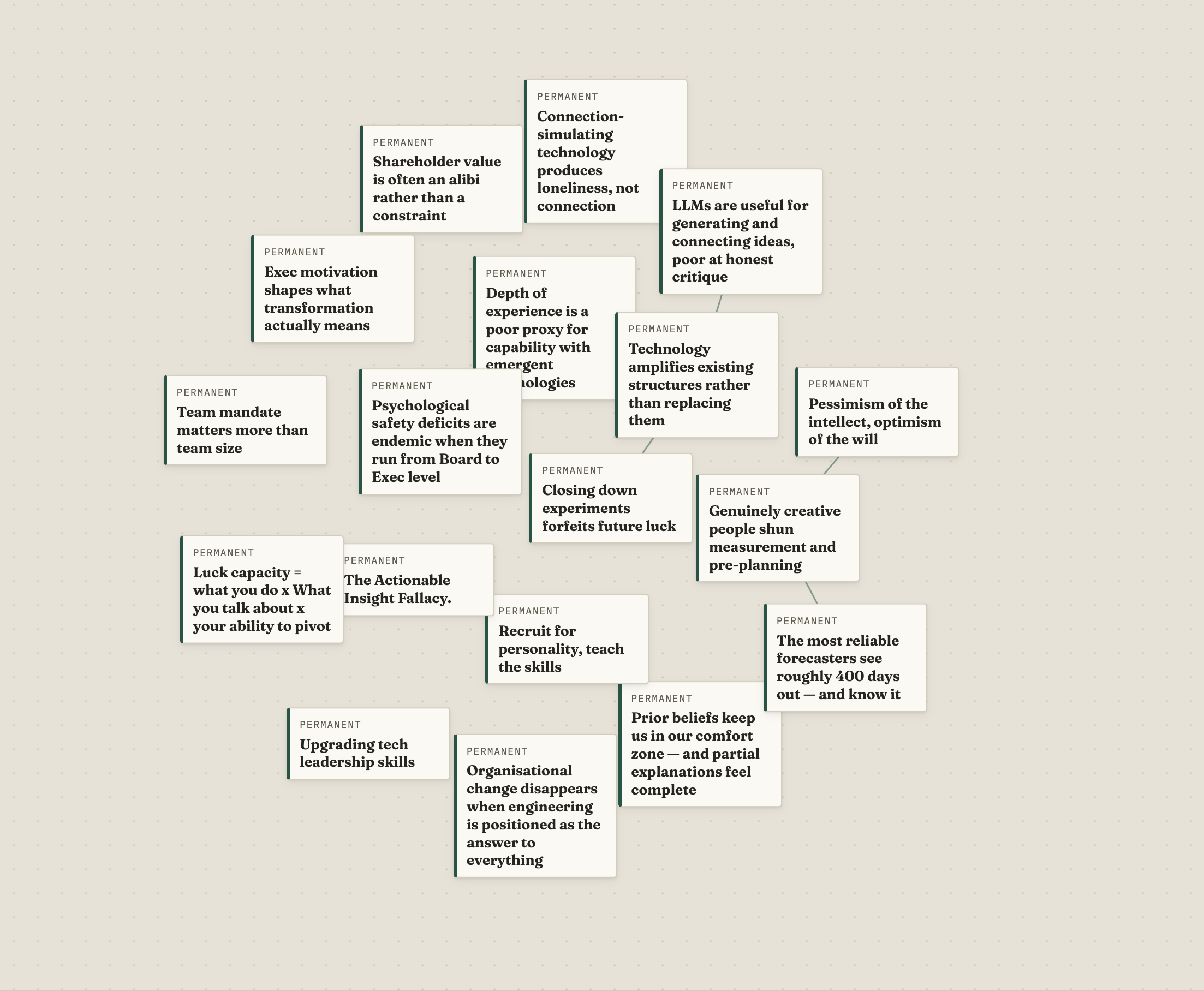
I’m not entirely sure if that last point is over-engineered, but I’ll continue to do it, as at the moment it feels like it might lead to something interesting (which is my general all-purpose hypothesis for experimentation).
This feels like a nice amalgamation of organic and structured processes. Since I keep most of the tech in a Claude conversation, it can adapt and change as I see fit. I could have built something more integrated into the Zettlekasten app, but it felt like it would tie me down to a set way of working when I don’t really know how any of this will work.
The experiments continue.


Nice to see a fellow use Kaweco Sport Brass as a pen to use for taking notes. I’ve also switched to using Kaweco Sport Brass pen for note taking when I switched from tech based notes to pen and paper based notes.