
This is, I hope, a hopeful story about generative technologies, and it starts by thinking about my drum machine.

I say “drum machine” in the singular, but I actually own four and have had a few more over the years. I will focus on a Behringer RD-8, a modern interpretation of the classic 1980s Roland model, the TR-808.
I’ve used drum machines in my music since the 1980s. They are instruments in their own right, and I have developed a style of using them over all those years. Drum machines allow me to make music. They are at the core of the music I make. I would struggle to make music without them.
I am not a drummer. I have never tried to drum, and I know I simply don’t have the skills to play the drums. I have two left feet and a dodgy arm.
Because I don’t drum, I am not constrained to using a drum machine like a drummer might be. I can program patterns of rhythm using sounds that are unimaginable to create using drums and a drummer.
Has my purchase and use of drum machines over the years put drummers out of work? No.
I’ve known and played with drummers over the years. Most of them are quite nice people, and some can keep time. It’s next to impossible to make a drum machine the punchline of a joke.
-/-
At the end of 2023, I had an idea for a new set of cards. A thing that would be like a tarot deck but for use in organisations. A provocation of conversations. That idea became the Business Meerkat card deck.
I started with a hand-drawn iteration which pushed my drawing skills to their limits. As you can see, my O-Level art teacher Miss Moon was pretty on the money when she told me in year 5 (year 11 in new money) that whilst I had a good eye, I couldn’t draw.
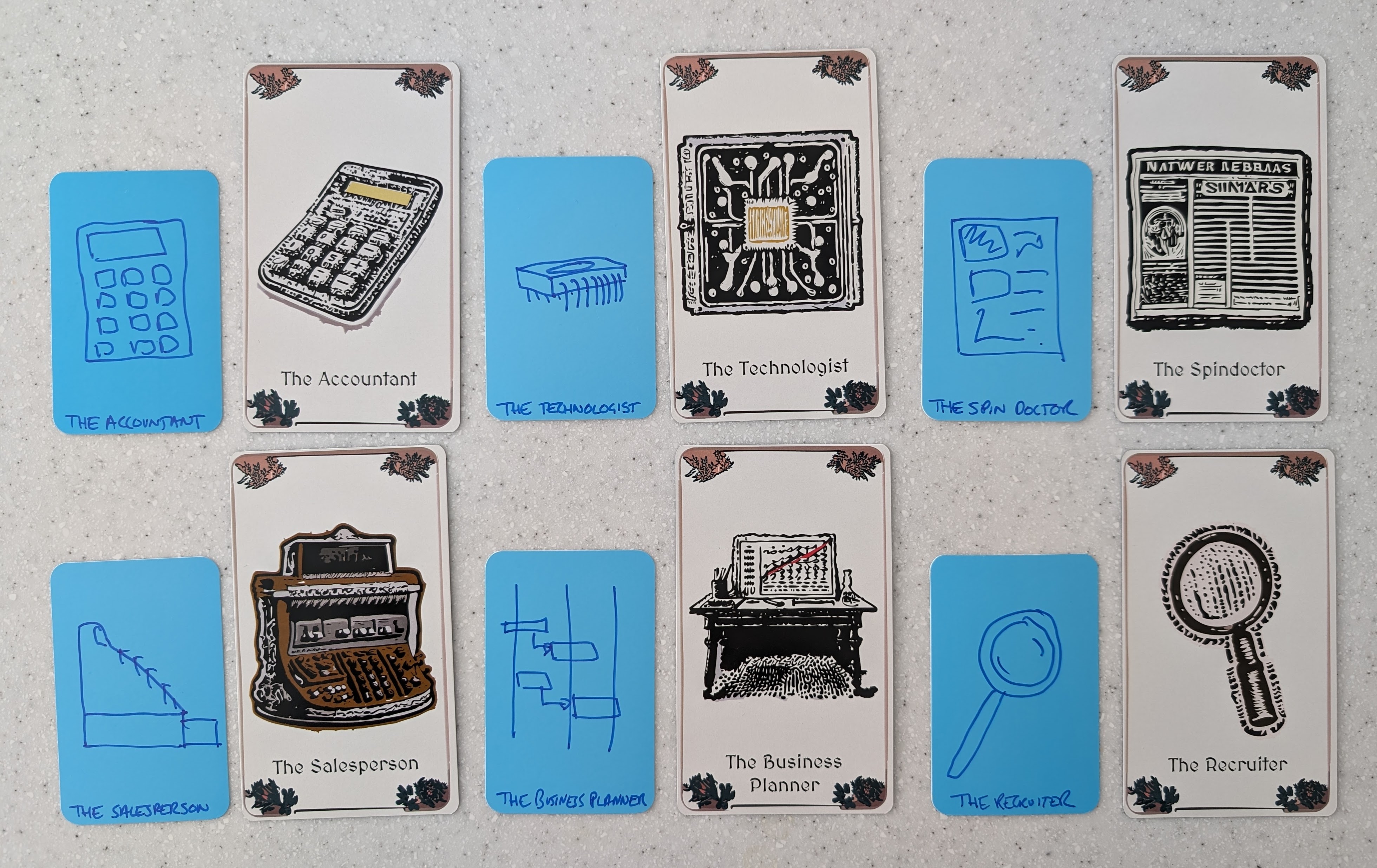
However, my stick drawings were enough to test the concept with a few people to see if it was worth pursuing. It seemed to resonate.
I had intended to talk to an illustrator at this point. For my last card deck, The Play Cards, I worked with Ellie Dallison, a graduate of Kingston University and a designer working through Studio KT1. It was great working with her, and I learned a lot about the process.
However, working with an illustrator dramatically increased my production costs. This, in turn, meant that I had to produce more cards and sell more cards to break even. This all took a lot longer and involved more risk associated with getting an idea out of my head and into the world.
I wanted to work more quickly and take less risk. I wanted the idea of the cards to come to fruition and be out in the world. None of these experiments are there to make me financially rich – they feed my curiosity.
So, I started to explore the generative tools in Adobe Illustrator. Quite soon, I realised that not only could I iterate my ideas more quickly, but I could also get to a publishable state on my own.
I had found my drawing machine, the equivalent of my RD-8 but for visual creation.
The tools in Illustrator are more nuanced than the Midjourneys and Dall-Es that get all the attention. They create infinitely editable vector images. They allow you to work within the constraints of style. They allow me to create the simulacra of what I’m trying to get out of my head. They allow me to fill the gap that Miss Moon identified in 1987, which has hung over me ever since.
The tools allowed me to create something that otherwise would have just remained stuck in my head.
-/-
Since publishing the cards last month and showing them to many people, one question has recurred: “Who did your illustrations?”
This is interesting on two levels.
Firstly, people don’t immediately think that they are machine-generated, and I think that, in part, is because of how I have run the process. The definition of the cards came first, then some clear thinking about what the illustrations for the cards should be. There was then careful prompting of the tools, and a level of editorial control to carefully select the ones that felt right. This wasn’t “Prompt Engineering”, it was an entire creative process.
And a process to which simply asking DALL-E to “Create a set of tarot cards for businesses” wouldn’t have been equivalent.
But secondly, I don’t really know how to answer. Again, with Miss Moon’s voice in my head whispering “you can’t draw” it feels disingenuous to say “I did”. But I wouldn’t have those qualms when it comes to describing who created some of my music. That wouldn’t be the RD-8.
At the moment, I’m compromising with “I did, using the generative tools in Adobe Illustrator”. That feels honest. The ideas were mine (as much as anyone’s ideas aren’t an amalgam of other people’s stuff culled consciously and unconsciously in one’s life).
-/-
Of course, this doesn’t mean that unscrupulous enterprises will not pick up on these technologies and find ways to deskill people and remove them from their payrolls. This is the way of the system.
But I think the hype that engulfs this stuff at the moment distracts us from the real opportunities that might lie at the heart of generative technologies.
As tools to assist and help, not to replace wholesale. Drum machines for words and pictures.
Doomsters will always predict doom. Technology companies will always find ways to sell technology that we neither need nor will use. It too will pass, and the useful stuff will remain.
 mmitII