
Nearly seven years ago, Chris Weston and I set up WB-40, a podcast loosely about technology. We didn’t really know what we were doing, and if you listen to some of the early episodes, that is abundantly clear.
A few years later, we were asked to help train some people in a government department technology team in how to make podcasts. By that stage, we had a bit more of an idea about what we were doing, and we’d also had some experience in training, so we were able to pull together some resources to help those teams create some audio.
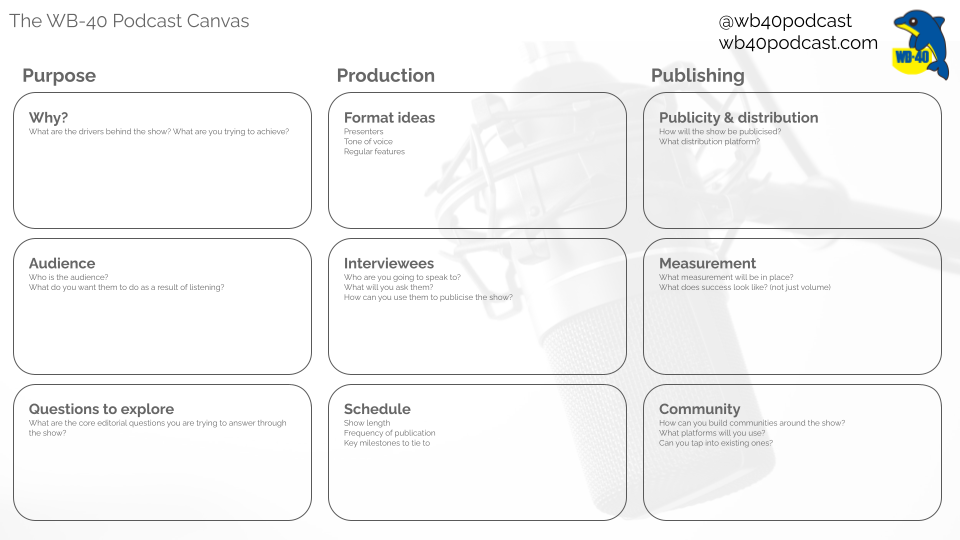
One of the things that came out of that work was the Podcast Canvas. Every so often people will ask me for some advice about podcasting, I’ll scrabble around to find the canvas, and then I’ll email it to them. This blog is mostly to improve that experience.
The canvas comes in three sections: here’s a bit more background to each…
Purpose – Why?
If you don’t know why you are doing it, creating a podcast will be very hard work. The reason why, though, doesn’t need to be too overblown. I’d done lots of radio stuff at university, love creating things, thought interesting things might happen, and so the big motivation behind WB-40 was to see what happened.
But you might be using it to raise your brand, educate your customers and prospects, communicate about a project you are doing. It’s worth understanding a bit about your why.
Purpose – Audience
One of the things I learned all those years ago at university about good radio was that it was about speaking to an individual. So it helps when thinking about your audience to do so in the context of the person as well as the group.
For WB-40, we think about our audience as people who are involved in the management of technology in organisations. That might include people who are in IT and Digital teams, but given how much technology has permeated into every nook and cranny of our modern world, just about anyone involved in business management in 2023 and beyond.
The other element of the audience question is what do you want them to feel or do as a result of listening to your show? For us it’s to feel better informed, above all else.
Purpose – Questions to explore
Over the time we’ve been making a podcast, we’ve refined the big question that we try to answer in what we are doing to something like:
“What do you need to know to manage technology in 2023 and beyond?”
It’s intentionally broad because that then gives us scope to speak with people from all sorts of backgrounds. You might choose to have a much narrower focus, but thinking of your show as the answer to a question is a useful way to frame what you do.
Production – format ideas
We’ve played with the format over the years, but at the moment have a three-part structure: an introduction which reviews the week that’s just been (including our guest if we have one), the interview itself, and then an outro previewing the week ahead in our lives.
Every quarter or so we have an Ask WB-40 show where we ask the audience for questions.
Giving the show a beginning, middle and end is important. I’d love to have more produced features, but the reality of the time we have available means our format can be recorded, edited and published all in one evening. That’s also worth keeping in mind when you are thinking of format ideas.
Production – interviewees
Who might you want to interview, assuming that interview conversations are a part of your format? Are there specific people you want to talk with? Or is it a type of people, or a particular professional group?
And what’s the hook for them to be involved? When we started back in 2016 podcasting was becoming much more popular. Today the market for guests is getting pretty crowded.
Production – schedule
How frequently are you going to record and publish? Sensible people probably restrict themselves to a season or seasons of shows (6, 10, 12) over the course of a year. We run weekly with breaks at Christmas, Easter and over the summer. We’ve hit something of a groove, but 35-40 shows a year take a fair bit of planning and production time.
Publishing – publicity and distribution
What channels will you use to publicize your show? Go where your audience might go would be the sensible advice. What existing social channels and audiences do you have? What hooks might you use to bring new listeners in.
Today it’s relatively straightforward to find platforms on which to publish, and many of them automatically syndicate through to the main podcast platforms.
Publishing – measurement
If you are intending to try to monetize your show, then measurement of your audience will be essential. We long ago gave up on that idea, and whilst we measured downloads for a while, it’s only really a proxy for listenership so we don’t really pay attention any more. Each of our shows generally was getting around 500 downloads over 3 months from publishing.
Publishing – community
The unintended (and glorious) consequence of the podcast is the community it has created. A few dozen people in a Signal group (previously on WhatsApp) who talk constantly about all sorts of things, some related to the show, many not.
Building a community around a show happened for us by accident, but what might you help to catalyze through your efforts? Or are there communities already in existence that you might tap into?
The technology – colophon
Not on the canvas, but as a useful line. in the sand for our current state for production in 2023, WB-40 uses the following stuff…
Hardware: we both have a decent mic, Chris uses one with a direct USB connection, I’ve got one that plugs into an external USB soundcard (I also use my computer for music making, hence the extra kit). We both use headphones for recording and encourage guests to too. If you want a recommendation for a Mic, the Marantz MPM 1000U is a good value starting point (it’s the USB version of the mic I use).
Software: there are three crucial bits of software that we use to record and edit: the free Audacity audio editing tool, Descript which allows for editing from a transcript, and can also remove ums and errs at a click, and Squadcast which provides our recording environment and allows for audio that is free of buffering and can be separated for each speaker (so you can kill background noise from one person).
Hosting: we use a WordPress hosted site.
You can download a PDF version of the canvas here…
 mmitII